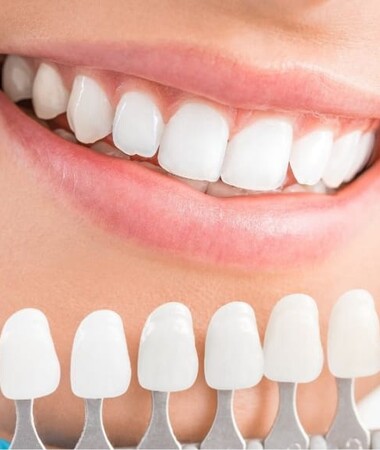
- Restore the natural color of enamel when teeth whitening fails to remove yellowing and discoloration;
- Eliminate the "tetracycline teeth" effect;
- "Mask" cracks and chips on the enamel layer, prevent the progression of caries, and further decay of the tooth;
- Close wide interdental gaps and eliminate the psychological discomfort caused by this defect.
In the smile zone, veneers are mostly used to correct aesthetic defects, while lateral teeth may require veneering due to functional issues.
Materials Used for Veneers
In today's dental practice, three types of dental veneers are distinguished:
- Composite veneers;
- Ceramic veneers;
- Lumineers.
Let's start by discussing composite veneers. These are plates made from composite resin (the same material used for fillings). They do not possess high strength or aesthetics like ceramics, but they are more affordable. Another advantage of such veneers is that they can be installed during a single visit to the dentist.
Ceramic veneers are made from various types of ceramics. They are not only strong but also provide a better imitation of natural tooth enamel compared to composites. These veneers are made from impressions and manufactured in a dental laboratory. They are slightly more expensive than composites.
Lumineers refer to ultra-thin ceramic veneers. They address the same problems and, despite their thinness, retain durability. Additionally, installing these veneers does not require drilling of hard tissues.
Preparation for Veneer Installation
Usually, the installation of ceramic veneers takes about 2 weeks and involves several visits to the dentist. One of the main stages of veneering is preparing the oral cavity. Before placing the plates, the dentist treats cavities, addresses other tooth issues to be covered by veneers, and prepares the teeth if necessary. The procedure is painless and often involves minimal reshaping.
Installation Process
When installing ceramic veneers at Varshavsky Dental Center in Vinohrady, Kyiv, the following process is followed:
- The dentist takes impressions of the teeth.
- The obtained impressions are sent to a dental laboratory, where the veneers for front or lateral teeth are fabricated.
- After a few days, the patient returns for a trial fitting, and final adjustments are made if necessary.
- The prepared veneers are bonded to the teeth using a special dental adhesive.
Composite veneers, unlike ceramics, can be installed in a single visit – the dentist forms the veneers directly in the patient's mouth. Once the composite hardens, the dentist shapes it to achieve the desired form. The final step involves polishing.
Advantages and Disadvantages of Veneers
The main advantage of the procedure is the quick achievement of results. This is particularly true with the use of composite veneers. Another benefit is the long service life, especially for ceramic products. Additionally, the transparency of modern materials allows for a highly natural result.
As for disadvantages, the main one is the higher cost compared to aesthetic restoration. Another downside of veneers is that they cannot be removed; they can only be replaced with new ones.